

Your lactate threshold helps explain how fast you can run before the effort becomes difficult to sustain. Learn what it means, how to recognise it without a lab test, and how to train it without turning every run into a hard one.
Short version: Lactate threshold is an intensity marker, not a universal pace or a fixed blood-lactate number. You can train around it with controlled tempo runs and intervals, but your progress still depends on the whole system: sensible progression, easy running and enough recovery.
What is lactate threshold?
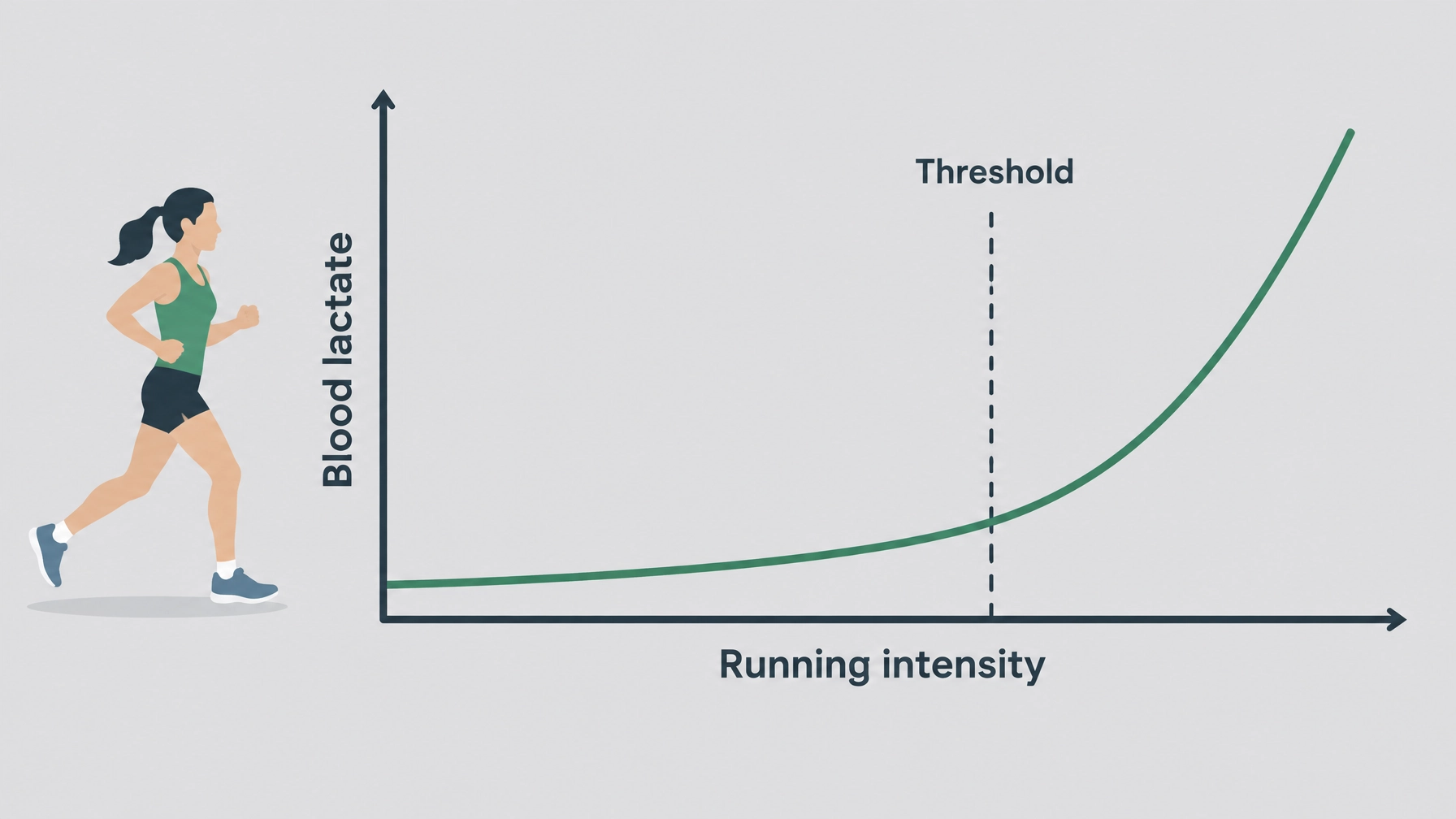
As you run harder, your muscles produce and use energy at a faster rate. Lactate moves from working muscle into the blood and can be taken up and used as fuel by other muscles and the heart.
At lower intensities, production and removal are generally well matched. As effort rises, there comes a point where blood lactate begins to climb more quickly than it can be cleared. This is often called the lactate threshold.
The term is used in different ways. Coaches and researchers may distinguish between a first threshold and a higher threshold, and the test method can affect the result. So it is better to think of threshold as a useful intensity range than a single, perfectly precise line.
You may also see 4 mmol/L used as a threshold marker. That is a population-based convention, not a personal measurement that applies to every runner. Your own response can differ, and lab results depend on the test protocol.

One common misunderstanding is that lactate is a waste product that causes muscle soreness. It is not simply waste: it can be transported and oxidised as fuel. The burning sensation during a hard effort is associated with several processes involved in intense exercise, not lactate acting alone. And next-day soreness is not caused by lactate left in your muscles.
Why does it help predict endurance performance?
Think of VO₂ max as the size of your aerobic engine. It describes the maximum rate at which your body can take up and use oxygen during exercise.
Threshold gives you another piece of the picture: how much of that engine you can use at a hard, sustainable pace. Running economy, or how much energy you use at a given speed, is another important part.
Two runners can have similar VO₂ max values but run at different speeds for the same effort. One may be able to sustain a larger fraction of their aerobic capacity, or use oxygen more economically. That can make threshold a useful predictor of endurance performance, often more practical for day-to-day pacing than VO₂ max alone.
It is not a complete forecast of race results. Course, weather, fuelling, pacing, experience and fatigue all play a part. In an ultra, for example, race effort is usually well below threshold, but a stronger aerobic base and better efficiency can still support steady running over many hours.
What does threshold feel like?
You do not need a blood test to get a useful sense of effort. A lab test can help set training zones, but it is not essential for most runners.
At a controlled threshold effort, running feels comfortably hard: purposeful and demanding, but repeatable. Your breathing is deeper. You could speak in short sentences, but you would not want to chat freely. You should be able to hold the effort without straining from the first few minutes or fading badly near the end.

Use the talk test as a guide, not a diagnostic tool:
- Easy running: conversation feels comfortable.
- Threshold effort: short sentences are possible.
- Very hard effort: speaking comfortably is difficult.
Pace and heart rate can add context, but neither is a perfect answer on its own. Heat, hills, poor sleep, stress and accumulated training fatigue can all change how a familiar pace feels. If your watch says “threshold” but your breathing and legs say otherwise, pay attention to your body.
How to develop your lactate threshold
Threshold work gives you practice running at a strong aerobic effort. Over time, training may help you sustain a faster pace at a similar effort. The response varies between runners, so build it around your current training and recovery.
Start with one threshold-focused session in a week, if you already have a consistent running routine and are absorbing your current load. For example:
- Controlled tempo: 20 minutes at a comfortably hard effort. As your training develops, you might build towards 30 to 40 minutes, provided you can keep the effort controlled.
- Threshold intervals: 3 × 10 minutes at a similar effort, with 2 minutes of easy jogging between repetitions.
- Steady-state running: a continuous, firm but more manageable effort below threshold. This can help build endurance without making every quality session a threshold test.
Warm up with easy running before the main work and cool down afterwards. Keep the first repetition measured. If you need to sprint to finish, or your pace falls away sharply, the session was likely too hard.

You do not need to add more repetitions every week. A modest increase in total work, followed by a week of holding steady or easing back, is often more useful than forcing constant progression. Adapt the session to your life as well as your fitness. A poor night’s sleep, a work-heavy week or a niggle may be a reason to shorten the workout or run easily instead.
For most busy recreational runners, one threshold session in a week is plenty. A second demanding session may suit a well-trained runner with a sound base and enough recovery, but it should not be added just because a training plan has an empty slot.
The rest of your running should support the work, not compete with it. Easy runs should feel easy enough to help you recover and build volume. If every run turns into a moderate shuffle, you can end up carrying fatigue without doing either your easy or hard training particularly well. My effort guide for simplifying training offers a practical way to think about this balance.
How does threshold work fit into ultra training?
In ultra preparation, long runs are a normal part of the training block. Their purpose is not to make every outing a threshold session. They help you practise moving for a long time, manage fuelling and build the capacity to absorb prolonged load.
Threshold work can support an ultra runner by improving aerobic efficiency and making stronger paces feel more controlled. But most of the week should still be at an easy or moderate effort appropriate to the athlete and event. The balance changes with experience, goals, terrain and recovery.
Do not use threshold training to replace the specific work your event requires. A long trail race may call for time on feet, climbing, descending and fuelling practice that a road tempo cannot provide.
Common mistakes to avoid
- Chasing a number: A pace, heart-rate value or 4 mmol/L reading is not automatically your threshold.
- Running too hard: Threshold should be controlled and repeatable, not a time trial.
- Testing too often: Fitness develops over weeks and months. Frequent testing can add fatigue without giving you a useful new decision.
- Ignoring recovery: The adaptation comes from training and recovering, not from collecting hard sessions.
- Forcing the session through a niggle: If discomfort changes your stride or worsens as you run, stop and reassess. My guide to returning to running after injury covers sensible steps for rebuilding.
Practical checklist
Before a threshold session, ask yourself:
- Have I built a consistent running base?
- Am I free from illness or a worsening niggle?
- Can I fit the session into the week without stacking it beside another demanding day?
- Do I have a clear effort target, rather than just a pace to chase?
- Can I adjust or stop if the effort is not coming together?
If the answers point to fatigue or a disrupted week, an easy run or rest day may be the better training decision.
Frequently asked questions
Do I need a lab test?
No. A lab test can estimate your thresholds and may be useful when you want more precise data. For general training, effort, the talk test and your ability to repeat the session can provide practical guidance.
Is threshold the same as tempo?
Not always. “Tempo” is used differently by coaches and runners. It often describes a sustained comfortably hard run, which may be near threshold, but the label alone does not define the intensity. Use the intended effort and session purpose.
How often should I do threshold work?
For many recreational runners, start with one session a week. Some experienced runners may handle two, depending on their training history, total load and recovery. More is not automatically better.
Does lactate cause muscle soreness?
No. Lactate can be used as fuel and clears relatively quickly after exercise. Next-day soreness is linked to other factors, including unfamiliar or demanding muscle work. It is not lactate sitting in your legs.
Key takeaways
- Lactate threshold is an intensity marker, not a universal pace or fixed blood-lactate value.
- It helps show how much of your aerobic capacity you can sustain, alongside VO₂ max and running economy.
- A controlled threshold effort feels comfortably hard, with speech limited to short sentences.
- Tempo runs, steady-state efforts and threshold intervals can develop this quality when progressed sensibly.
- Easy running, load management and recovery remain essential, including in ultra training.
This article is training guidance, not medical advice. Consult your GP if you have persistent symptoms, a fever, chest pain or a specific health condition that could affect exercise.


