


When it comes to running, understanding how hard you are working can be as important as the distance covered. Effort perception, or how you feel, plays a pivotal role in an athlete’s journey, and understanding how you feel when running in relation to pace, heart rate or training zone is an important skill to master in helping optimise workouts and avoid burnout.
While heart rate, pace and power can give you an indication of how hard you are physically working, effort perception isn’t just about the physical, it’s also about the mental aspects of endurance, which can impact performance significantly. Here are some key elements to consider:
- Effort is subjective: what may feel like an all-out effort for one athlete could feel comfortable to another. This individuality matters when considering training structure and race pace.
- Psychology: has a huge impact on an athlete’s perception of effort. Running 9min/mile might have felt fine last week, but this week the athlete’s mindset is negative for some reason, and that same 9min/mile feels harder, even though physically it’s likely the same effort.
- A holistic approach to training, incorporating effort perception like the Rate of Perceived Exertion (RPE) and the Talk Test, allows athletes to gauge their intensity levels better, leading to informed training decisions that take into account how they feel on any given day.
Understanding and embracing these factors can transform how athletes engage with their workouts, making them more achievable and enjoyable, and ultimately enhancing performance. That’s why at PFM Coaching I use a combination of pace, heart rate and RPE when assigning training, often providing all three as an option within an individual workout.
Rating of Perceived Exertion (RPE)
What Is RPE?
The Rating of Perceived Exertion, commonly known as RPE, is a subjective scale that allows individuals to assess their effort during physical activity. It was developed in the 1960s by Swedish researcher Gunnar Borg. PFM Coaching uses a version of this scale where RPE runs from 0 to 10, as below:
- 1–3: A light effort
- 3–5: Light to moderate effort
- 5–6: Moderate effort
- 6–8: Vigorous effort
- 9–10: Max effort
This RPE scale gives runners and athletes an easy way to gauge how hard they feel they’re working, taking into account physical sensations such as breathlessness and muscle fatigue.
Benefits of Using RPE in Running
- Personalised training: RPE helps athletes adjust their intensity based on how they feel, rather than relying only on pace or heart rate.
- Injury prevention: Monitoring RPE can prevent overexertion, allowing athletes to listen to their bodies and avoid injuries.
- Enhanced mental toughness: By consciously pushing through perceived barriers, athletes can improve their ability to handle discomfort during intense workouts.
- Reduces anxiety: Many athletes worry about hitting pace targets or holding a particular heart rate. Aiming for an RPE can take the focus off the numbers.
- Requires no equipment: You don’t need a watch or heart rate monitor to tell you that you’re at the target intensity.
- Suitable for all terrain: RPE is great for judging effort regardless of terrain, so it’s particularly suited to trail and ultra runners.
Using RPE not only develops a deeper understanding of how the body is responding, but also allows the athlete or coach to make informed decisions when tailoring training for optimal performance.
The Relationship Between Effort and the Talk Test
The Talk Test is an intuitive way to assess exercise intensity, especially for runners looking to gauge their effort level without gadgets, making it well suited to those just starting out but equally useful for more experienced runners. Simply put, the Talk Test evaluates how comfortably you can converse during your workout. Used in running, it becomes an excellent tool for determining whether you’re training at a light, moderate, or vigorous intensity.
- Low intensity: if you can chat easily, you’re likely at a low intensity (RPE 2–3).
- Moderate intensity: if you can speak but need to pause for breath, that’s moderate (RPE 4–6).
- Vigorous intensity: struggling to complete a sentence? That’s a sign you’re in the vigorous range (RPE 7–8).
Studies support this relationship, showing that when talking becomes difficult, you’ve likely crossed into a more intense workout.
Incorporating the Talk Test Into Your Running Routine
- Set a baseline: start by assessing your talking comfort level during an easy run.
- Adjust based on feel: as workouts progress, listen to your body, if talking feels laboured, you may need to dial back the intensity.
- Use it on interval days: during high-intensity intervals, aim for those no-talking zones. This will build endurance and speed.
Remember, the Talk Test isn’t just about numbers, it’s an opportunity to listen to your body and enhance your running experience!
Training Zones in Running
Understanding training zones is essential for effective running. These zones correspond to the intensity of your efforts and can guide your workouts toward specific goals. Here’s a breakdown of how PFM Coaching applies these zones:
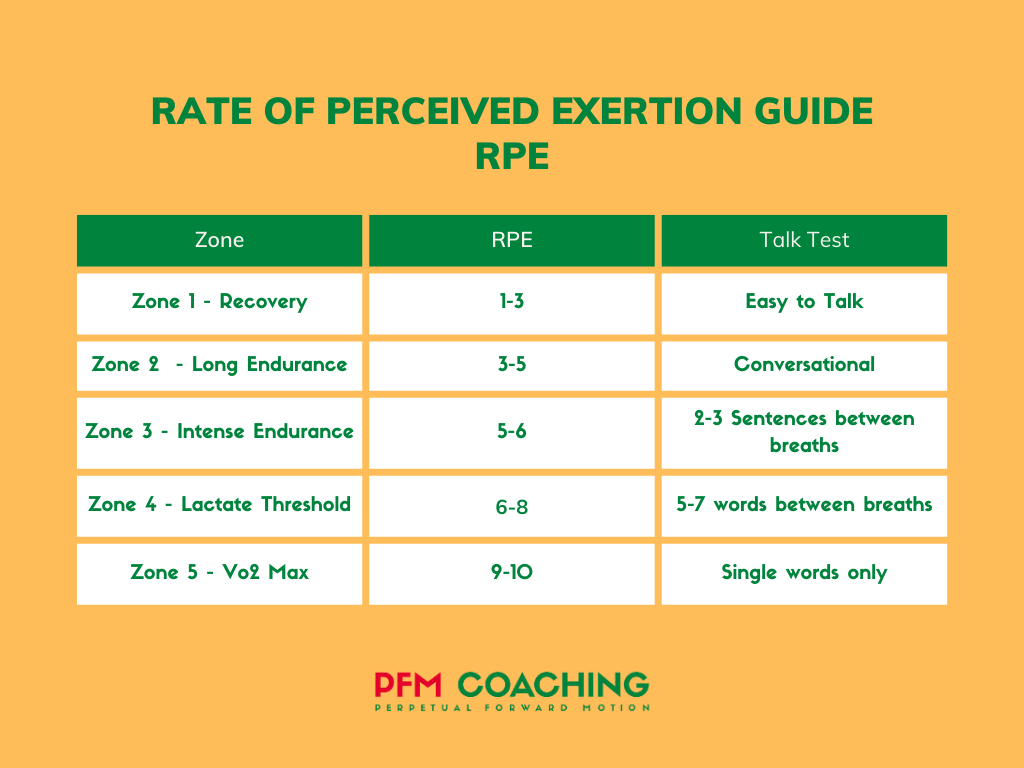
- Recovery Zone (1–3 RPE): It’s very easy to hold a conversation. This zone is ideal for recovery runs or long, steady sessions.
- Long Endurance Zone (3–5 RPE): Still a conversational effort, ideal for building endurance with limited stress on the body.
- Intense Endurance Zone (5–6 RPE): You can now only speak a few sentences at a time. This gives much the same adaptations as the Long Endurance Zone but requires more recovery time, so it’s not used often (maybe for race-pace familiarisation).
- Lactate Threshold Zone (6–8 RPE): Breathing becomes laboured and conversation is challenging. This zone is great for high-intensity work to develop the body’s ability to maintain a higher intensity for longer.
- VO2 Max Zone (9–10 RPE): Now only able to speak a word or two at most. Used for short and very intense efforts.
How to Determine and Use Your Training Zones
To effectively use these zones, listen to your body. Keep a journal noting RPE levels after each run. PFM Coaching uses a coaching platform that lets you log this information by giving each run a “how it felt” rating, along with space to leave comments.
- Start simple: use the Talk Test to find your comfort levels.
- Adjust as needed: on days when you feel off, don’t hesitate to run at a lower zone to avoid overtraining.
- Set goals: focus on specific zones for different workouts, easy runs for recovery, easy-to-moderate runs for endurance, and hard efforts for speed. If you’re one of my athletes, this is taken care of for you.
By strategically cycling through these training zones, you can optimise your training adaptations, and your performance, while enjoying your running journey even more!
Psychological Factors Affecting Effort Perception
The Mind-Body Connection in Running
The mind-body connection plays a crucial role in how athletes perceive effort during their workouts. Recent studies highlight that our emotional state significantly influences our perception of exertion. When athletes feel positive, they may underestimate the intensity of their efforts, making workouts feel easier. Conversely, negative emotions can amplify feelings of fatigue, making it seem as if every mile is an uphill battle.
Strategies to Improve Effort Perception
- Self-talk: positive affirmations can enhance performance, helping athletes better endure tough workouts. A mantra like “I can do this” can shift perceptions from struggle to achievement.
- Focus on breath: coordinate breathing with steps to enhance relaxation and decrease perceived effort.
- Mindfulness practices: engage in mindfulness exercises to promote a positive mindset during runs.
- Visualise success: picture positive outcomes to reduce anxiety and boost confidence.
By applying these strategies, athletes can better manage how they perceive effort and transform their running experience!
For a simplified approach to applying these principles, read my post Simplify Your Training: The Traffic Light Effort System.


