

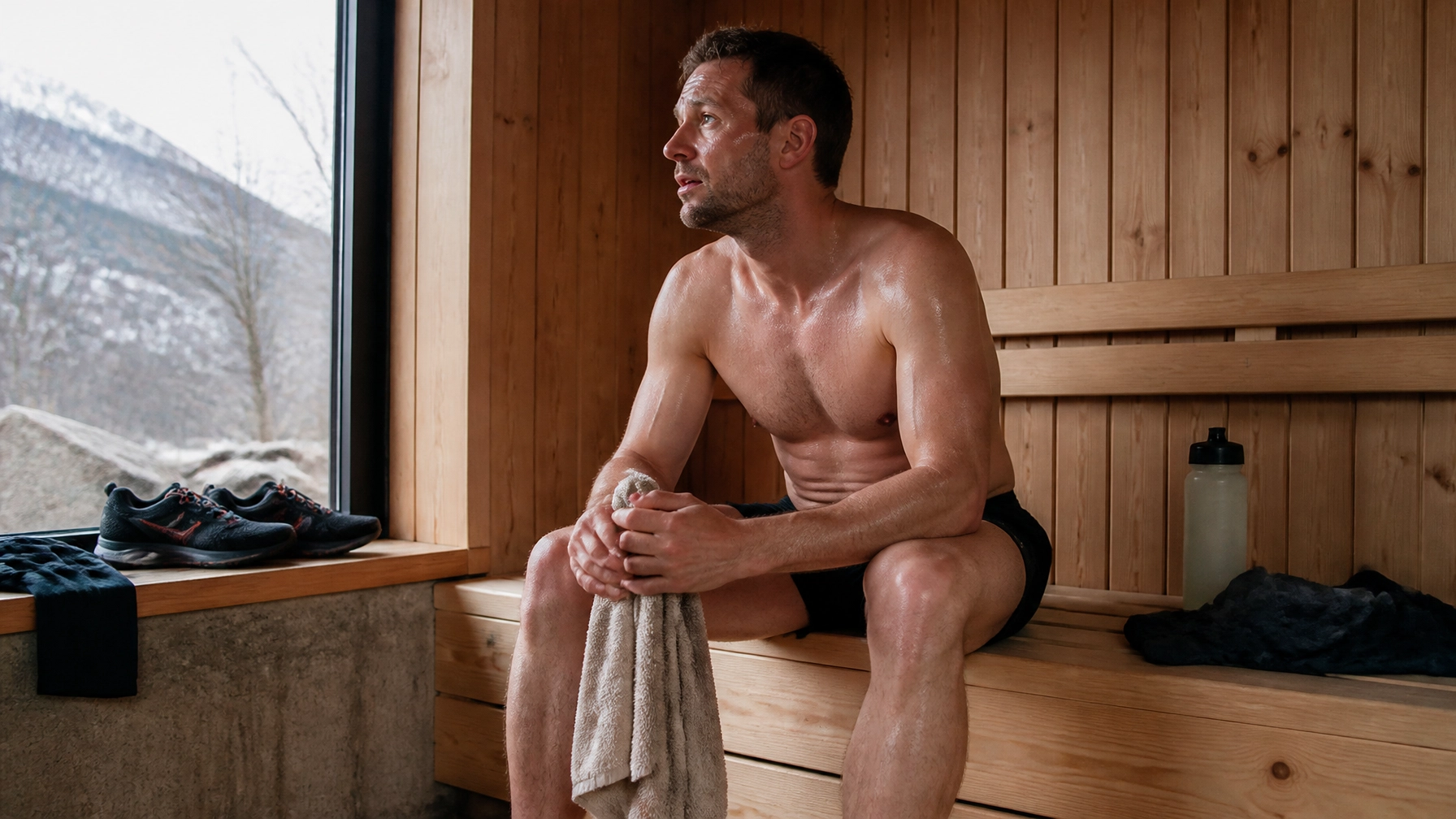
Heat adaptation works best when it is planned like a protocol, not guessed on the fly. The heat stimulus is daily; the running still follows your training plan.
Heat adaptation gives you a better shot at running well when the forecast turns hostile. Done properly, it helps you hold effort, manage heart rate, and stop the day unravelling just because the temperature climbs.
Short Version: Heat adaptation isn't just about "suffering through it." It’s a physiological upgrade that takes daily heat exposure for 10–14 days to lock in, and that does not mean running every day. By strategically exposing your body to heat, you expand your plasma volume, effectively giving your heart a bigger pump and your muscles more oxygen. The smart play is a hybrid approach across that 10–14 day window: active adaptation means exercising in the heat on running days, while passive adaptation means heat exposure without exercise such as a sauna or hot bath after a session or on a rest day. That adaptation work is separate from race-day pacing adjustments, which are about managing the conditions on the day rather than building the adaptation itself.
The heat is often viewed as the enemy of the PB. We see a forecast of 25°C and immediately start adjusting our expectations downward, bracing for the inevitable "slog." As an ultra running coach, I want you to look at heat differently.
In the coaching world, we often call heat training "the poor man’s altitude."
When you train in the heat, you aren't just getting better at sweating; you are forcing your body to undergo physiological shifts that mimic the benefits of high-altitude training. Get the protocol right and you show up to race day with a cooling system that’s more efficient and a blood volume that can handle the load. Get it wrong and you’re just digging a hole of fatigue that will see you shuffling, second-guessing yourself, and hitting the wall hard.
The Science: Why "More Blood" Wins
The benefitof heat adaptation lies primarily in plasma volume expansion. When you’re hot, your body is in a constant tug-of-war. It needs blood to go to your working muscles to provide oxygen, but it also needs to send blood to the skin’s surface to dump heat through sweat.
By following a structured protocol, your body reacts to this stress by increasing the total amount of plasma (the liquid part of your blood).
- More plasma means more blood can be sent to the skin without starving the muscles.
- More plasma means a lower heart rate for the same level of effort.
- More plasma means you can "absorb the load" of a hot race without your internal temperature skyrocketing.
According to UESCA standards, it takes about 10 to 14 days to achieve these major shifts. You can't rush biology. Consistency beats intensity every single time here.
The 14-Day UESCA Protocol
We don't just go out and smash hill reps in a heatwave. That’s a recipe for burnout and niggles. We follow a tiered approach to ensure your personalised running coaching plan stays on track.
The key point: the heat stimulus should be daily for 10–14 days if you want the plasma volume gains to stick. That is not the same as running every day. Running creates mechanical load. Heat exposure creates thermal load. They overlap, but they are not the same job.
The smart approach is hybrid:
- Workout days: use active adaptation, meaning exercise in the heat.
- Rest or recovery days: use passive adaptation, meaning heat exposure while not exercising such as a sauna or hot bath after a session, or on a non-running day.
- Goal: keep the heat signal going across the full 10–14 day protocol without turning your legs to concrete.
Stage 1: The Early Phase (Days 1–5)
The Goal: Trigger the initial plasma expansion.
Active Heat (running days): Low intensity, 30–60 minutes.
Passive Heat (rest/recovery days): 20–30 minutes sauna or hot bath.
This is where we embrace the "shuffle." Your heart rate will likely be higher than usual for your standard "easy" pace. Don't fight it. Keep the effort strictly at a conversational level. We are looking for a gentle rise in core temperature, not a full-blown meltdown. On non-running days, the sauna or bath keeps the adaptation moving without adding extra pounding.
Stage 2: The Mid Phase (Days 6–10)
The Goal: Increase sweating efficiency.
Active Heat (running days): Gradual intensity increase.
Passive Heat (rest/recovery days): 20–30 minutes sauna or hot bath.
By now, your body is starting to adapt. You’ll notice you start sweating sooner and more profusely. We can now start introducing moderate efforts, perhaps some steady-state blocks, while maintaining the daily heat exposure. If the plan calls for an easy day or full rest, you do not force another run just to tick the heat box. You use passive heat and keep the system under control.
Stage 3: The Late Phase (Days 11–14)
The Goal: Race-specific durability.
Active Heat (running days): Goal pace efforts in the heat.
Passive Heat (rest/recovery days): 20–30 minutes sauna or hot bath.
This is the final polish. We want to see how your body handles race-day intensity under thermal stress. This is also the time to fine-tune your marathon training plan hydration strategy. Again, the rule stays the same: daily heat exposure, not daily running.

Active vs. Passive Methods
As an online running coach, I often work with athletes who live in the UK but are prepping for races in hotter climates. We have two main ways to prepare, and they should not be lumped together as if they do the same job in the same way.
Both sit inside the same 10–14 day heat adaptation protocol aimed at expanding plasma volume. They are not the same thing as race-day pacing changes. Adaptation is what you do in the days before the race to change physiology. Pacing adjustment is what you do on race day to manage the conditions you get.
1. Active Adaptation
This means exercising in the heat. Usually that is running in hot conditions, or creating heat stress during a run if the weather is mild. If you don't have naturally high temperatures, we use "layering." This means wearing extra leggings or a jacket to trap metabolic heat. Warning: This is high-stress. It gives you the heat stimulus and the mechanical load of running. That can be useful on workout days, but if you stack too much of it, form gets messy, niggles creep in, and the whole week starts to wobble.
2. Passive Adaptation (The Sauna/Hot Bath)
This means heat exposure while not exercising. It is a game-changer for busy professionals and for athletes who need the heat signal without extra pounding. On rest days or recovery days, or after an easy session, you spend 20–30 minutes in a sauna or a hot water immersion (HWI) bath (approx. 40°C).
- The benefit: You get the heat stress without the added mechanical impact on your joints.
- The use case: This is how you keep the daily heat exposure going across the full 10–14 day protocol without forcing yourself to run every day.
- The Rule: Do not hydrate during the sauna session (save it for immediately after). We want the body to sense the slight fluid deficit to trigger that plasma expansion.
Plain English: use active adaptation when you are exercising in the heat. Use passive adaptation when you are getting heat exposure without exercising. Both help drive plasma volume expansion during the 10–14 day build-up. Neither should be confused with race-day pacing adjustments.

The Math: Sweat Rate & Pacing
You cannot manage what you do not measure. In the heat, your "gut feeling" about hydration is usually wrong.
How to calculate your sweat rate (UK Metric)
To get an accurate picture, perform a 60-minute "Sweat Test" in race-like conditions:
- Weigh yourself naked before the run (in kg). Let's call this A.
- Run for 1 hour at race intensity. Keep track of exactly how much you drink (in litres). Let's call this Z.
- Towel off and weigh yourself naked again. Let's call this B.
The Formula: (A - B) + Z = Hourly Sweat Rate
If you started at 75kg, finished at 74.2kg, and drank 0.5L, your sweat rate is 1.3 litres per hour. Aim to replace roughly 70–80% of this volume during your race to avoid "heavy legs."

The Pacing Adjustment Rule
This section is about race-day adjustment, not heat adaptation. By this point, the 10–14 day adaptation block is already done. Now you are managing the conditions in front of you.
If you ignore the heat and try to carry on as normal yu will likely hit the wall early and hard. A running coach looks at the environmental data, not just the GPS when setting pacing expectations.
The Guide: For every 5°C increase in temperature above 15°C, expect to adjust your pace by 8-12 seconds per kilometre.
If it’s 25°C out, and you try to run your 15°C PB pace, your core temperature will redline before you hit the halfway mark. Adjust early or suffer late.
The Trap: Don't Overcook the System
The biggest mistake I see as a running coach is athletes trying to "win" at heat training. They go too hard, too soon, and end up with a suppressed immune system or a "niggle" that won't go away. It often starts with good intentions and a bit of anxiety about the race, then turns into poor decisions once the body is already carrying more load than it can absorb.
Heat is a stressor just like mileage. We have to adapt the plan as we go. If you are feeling chronically tired or your resting heart rate is spiked, we back off. The goal is to arrive at the start line resilient, not roasted.
Key Takeaways
- Timeline: Allow 10–14 days of daily heat exposure for full adaptation.
- Physiology: You are training for plasma volume expansion and better cooling.
- Method: Use active adaptation by exercising in the heat on running days, and passive adaptation through heat exposure without exercise on rest or recovery days.
- Threshold: Aim for a core temp rise for about 90 minutes (through active or passive means).
- Math: Know your sweat rate and adjust your pace by ~10s/km for every 5°C jump.
- Recovery: Heat training is taxing; prioritise sleep and "system management."
FAQ
Q: Can I just do saunas and not run in the heat?
A: Yes, passive adaptation is highly effective for plasma expansion, because passive adaptation means heat exposure without exercise. That said, you'll miss out on the specific movement and pacing feel that comes from active adaptation, which means exercising in the heat. For most runners, the best answer is a hybrid across the full 10–14 day protocol: exercise in the heat on workout days, use sauna or hot bath after a session or on rest days.
Q: Should I use salt tablets?
A: If you are a "salty sweater" (white streaks on your kit), yes. But this should be based on your sweat test results and integrated into your personalised running coaching plan.
Q: Is it too late to start 5 days before a race?
A: You’ll get some minor benefits, but you won't get the full plasma expansion. At that point, your focus should be on hydration and pacing strategy rather than trying to force an adaptation.
Ready to stop guessing and start progressing?
Whether you’re aiming for a 5K PB or a 200-mile ultra, I provide bespoke, human-led coaching that adapts to your life and the environment. Let’s talk about your goals and build a plan that actually works.


