

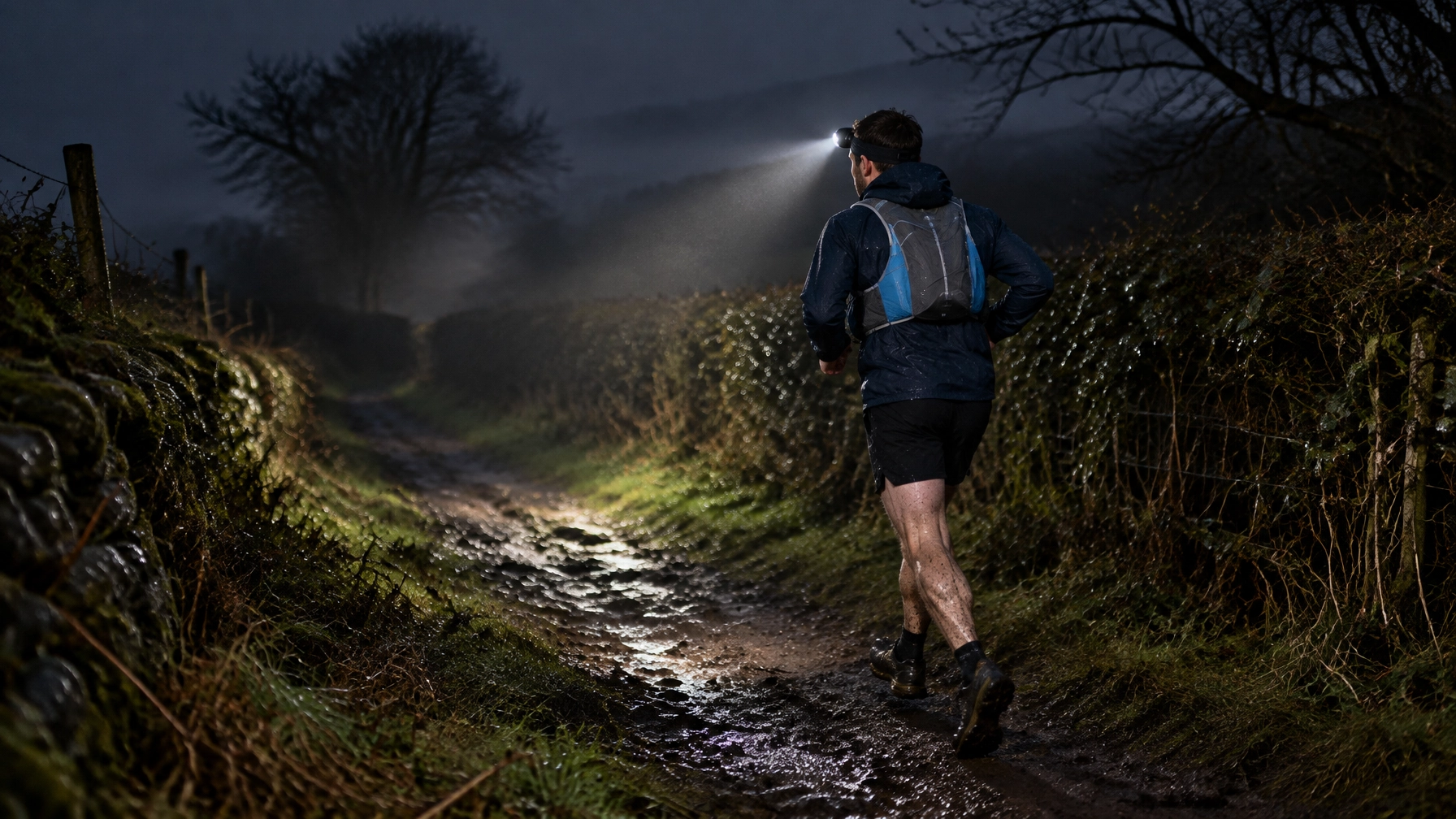
Most first-time ultra runners train almost entirely in daylight, then meet the dark on the Taff Trail or Wales Coast Path with tired legs, cold hands and no plan. Night running needs to be trained as a skill, not left to race day.
TL;DR
- Rehearse running in darkness before your ultra, including navigation, fuelling and clothing.
- Use a reliable head torch, carry a backup light and consider a hand-held light for better shadows.
- Follow your route without staring at a screen. Load the course into your watch and use Komoot as part of a wider navigation system.
- Expect fuelling to feel harder at night. Use small, regular feeds and practise different gels, chews and drinks.
- Sleep deprivation affects judgement before it affects your legs. Slow down, stop, eat, warm up or rest when needed.
- Mental dark patches are predictable problems to manage, not evidence that you cannot finish.
The gap in most ultra marathon training
A runner can complete a long run, climb hills and practise eating on the move. But if every session finishes before sunset, they may still be unprepared for the section that causes the most trouble.
Darkness changes the job.
Roots are harder to spot. Mud looks flatter than it is. A familiar path can feel unfamiliar. You may start checking your watch too often, worrying about every junction and losing the steady rhythm you built in daylight.
On a winter ultra in Wales, the conditions may also include rain, wind, saturated ground and temperatures dropping as the night progresses. Add twelve or eighteen hours of movement, and small problems become harder to solve.
The goal is not to become comfortable with every possible problem. The goal is to practise solving common problems while tired.
That is a key part of good ultra marathon training.
Train the dark before race day
You do not need to run through the whole night every week. That would add too much load and interfere with recovery. You do need regular, controlled exposure to the conditions you will face.
Start with one of these options:
- Begin a steady run in the final daylight and finish in darkness.
- Start before dawn on a familiar route.
- Complete a longer run with two or three hours after sunset.
- Rehearse a race section at the same time of night, if it is safe and practical.
- Practise after a slightly shorter night of sleep, without creating a pattern of chronic sleep deprivation.
That does not mean avoiding long runs. In ultra running, long runs are the norm rather than the exception. Sessions of two and a half hours or more are a normal part of preparing for a 43-mile race, a 100-miler or a 200-mile event, and they need to be built progressively rather than bolted on at the last minute.
The question is how they are scheduled. A long run earns its place when it has a clear purpose, such as rehearsing race conditions, testing your full kit and fuelling system, or building the confidence that comes from time on feet. It also needs to be paired with adequate recovery, sensible pacing and enough sleep and food around it. The mistake is treating every long run as a test of toughness.
During these sessions, test the full system:
- Head torch and spare light
- Battery life
- Waterproof layers
- Gloves and hat
- Navigation
- Fuelling
- Caffeine timing
- Foot care
- Your ability to make sensible decisions when tired

Head torch, backup light and shadows
A head torch is your main light, but it should not be your only light.
Choose one that is:
- Bright enough for the terrain
- Comfortable and stable over several hours
- Resistant to rain
- Simple to operate with cold fingers
- Able to run for longer than your expected dark section, with a safety margin
You do not need to chase the biggest number on the packaging. A wide, even beam is often more useful than a narrow, intense beam when you are picking through mud, stones and tree roots.
Carry a backup light where you can reach it without emptying your entire pack. This could be a second head torch or a small hand-held torch. Keep spare batteries protected from water and cold.
A hand-held light can also help with shadows. A beam coming from your head tends to flatten the ground. A light held lower or to one side can show the shape of a rut, rock or drop more clearly. On technical ground, this can reduce hesitation and improve foot placement.
Practise changing batteries or switching lights before race day. Cold hands and tired thinking make simple tasks slower.
Navigation: use the screen less, prepare more
At night, navigation should be boring.
Load the official route onto your watch and phone in advance. If you use a COROS watch, check the route, battery setting and navigation alerts during training rather than waiting until the start line.
Komoot can help you plan or review a route, import a GPX file and download maps for offline use. Use it as part of your navigation system, not as an excuse to run with your phone permanently in your hand.
My preferred approach is:
- Review the route before setting off.
- Note major junctions, road crossings, water points and likely decision areas.
- Download the route for offline access.
- Follow the route through your watch or voice prompts where appropriate.
- Stop in a safe place if you are unsure.
- Confirm your position using the map rather than chasing a blue line while moving.
You should also carry a charged phone, a route file and a basic map and compass where the event’s kit requirements call for them.
The screen is a tool. It is not a substitute for looking around you.
At night, a small wrong turn can become a long detour. A minute spent checking properly is cheaper than an hour spent correcting a mistake.
Fuelling when nothing tastes good
Night fuelling is often less about hunger and more about routine. Your appetite may drop. Gels can feel too sweet. Chews may become difficult to swallow. Cold air and tiredness can make the whole process feel like work.
Do not wait until you feel empty.
Use small, regular feeds and practise a mixture of options:
- Gels
- Chews
- Carbohydrate drink
- Bananas or other familiar food
- Small savoury items if you tolerate them
Many runners use a broad range of carbohydrate targets during ultras. Your correct intake depends on pace, duration, gut training and what you can absorb. Start with a manageable amount in training and build it gradually. My marathon fuelling guidance covers the same basic principle: fuel proactively, not only when you feel yourself fading.
If a gel becomes unappealing, change the texture or flavour rather than abandoning fuelling completely. Small sips and bites are usually easier than forcing a large feed at an aid station.
Caffeine can help alertness, but it needs a plan. A modest dose before or near the beginning of the night section may be useful. Smaller top-ups may be more appropriate than one large amount. Practise this in training and account for your normal sensitivity, anxiety levels and stomach response.
If you may need to sleep, avoid taking caffeine so late that it prevents useful rest. The right decision during a long ultra is sometimes to stop, eat, warm up and sleep briefly rather than continue making poor decisions.
Cold, wet and tired: manage the system
In Wales, a night run can move from merely damp to properly wet within minutes. Wind on wet clothing is more serious than rain alone, especially when you are moving slowly or stopping at checkpoints.
Carry and practise using:
- A proper waterproof jacket
- Spare gloves
- A warm hat or buff
- Dry layers protected in a waterproof bag
- Spare socks where the race allows them
- Blister and foot-care supplies
- An emergency layer or blanket as required
- A rear light or reflective element for road sections
You may not keep your feet completely dry. That is not the only target. The target is to manage moisture, grit and hot spots before they become a problem.
Check your feet at planned points. Remove debris. Change socks when it is worthwhile. Deal with a hot spot early rather than hoping it disappears.

What sleep deprivation does to decision-making
Sleep loss does not only make you feel tired. It affects concentration, reaction time, mood and judgement.
You may:
- Miss obvious route markings
- Forget to eat or drink
- Become fixated on a minor problem
- Take unnecessary risks
- Struggle to decide whether to add or remove a layer
- Read normal fatigue as a sign that something is seriously wrong
This is why race plans need decision points before the night begins.
For example:
- If you miss two planned feeds, stop and reset.
- If you are shivering uncontrollably, deal with warmth before continuing.
- If you are repeatedly veering or experiencing microsleeps, stop moving and seek help.
- If a niggle changes your gait, reduce the load rather than forcing the planned pace.
Sleepiness is a safety issue, not a character test.
A short controlled rest can improve alertness during a long event. For some runners, a few minutes at a checkpoint is enough. Others may need longer. The decision should be based on safety, the race format and the support available.
The mental dark patch
There may be a point when you feel flat, anxious or disconnected from the purpose of the race. This can happen when the route is quiet, the weather is poor and the next checkpoint feels distant.
The starting line is never just physical. Work stress, low mood, family pressure and poor sleep can still be present when the race begins. Darkness can make those feelings louder, but it does not automatically mean your race is failing.
Break the problem down:
- Eat something.
- Drink.
- Check your clothing.
- Slow the pace.
- Confirm the route.
- Decide on the next safe checkpoint.
- Reassess there.
Do not make a permanent decision in the middle of a temporary low point unless there is a genuine safety concern.
At the Dragon 100 and the Wild Horse 200, the night sections taught me the same basic lesson: the dark is not dramatic. It is simply another set of conditions to manage. Your light may need changing. Your feet may need attention. Your food may need adjusting. Your pace may need to become a shuffle.
That is all useful information.

Night-run checklist
Before a dark training run or race section, check:
- Head torch charged and tested
- Backup light packed and accessible
- Spare batteries protected from water and cold
- Hand-held light considered for technical ground
- Route loaded onto watch and phone
- Offline map available
- Phone charged
- Map, compass and mandatory kit packed
- Waterproof jacket and warm layers ready
- Gloves, hat and spare socks considered
- Gels, chews and drinks portioned
- Caffeine timing decided
- Foot-care kit packed
- Safe route and check-in plan confirmed
- Clear decision points agreed for stopping, warming up or resting
Training for the Brecon to Cardiff Classic in February? Most of the field finishes after sunset, so these sessions matter. My free Brecon to Cardiff Ultra Playbook covers the course segment by segment and gives you a 16-week framework to build your dark-running practice around.
Key Takeaways
- Dark running is a skill. Rehearse it progressively during autumn and winter.
- Use redundancy. Carry a backup light and do not rely on one device.
- Navigate deliberately. Use Komoot, your watch and offline maps without staring at a screen for every step.
- Fuel by routine. Appetite is unreliable at night, so small regular feeds are useful.
- Protect decision-making. Slow down or rest before tiredness turns into a safety problem.
- Treat mental lows as manageable. Eat, drink, warm up, adjust and reassess.
Short FAQ
How often should I run in the dark before an ultra?
For most runners, a few purposeful sessions are more useful than frequent exhausting night runs. Include shorter familiarisation runs, then one or two longer rehearsals that test your kit and fuelling.
Do I need to run through a whole night in training?
Usually not. You need enough exposure to understand how you respond to darkness, tiredness and cold. Chronic sleep restriction creates unnecessary recovery problems.
Should I use my phone for navigation?
Use your phone as a backup and for route checking. Download the map for offline use, but avoid running with the screen constantly in your hand. Your watch, route knowledge and basic navigation skills should share the job.
What if I cannot eat during the night section?
Change the delivery method. Try smaller amounts, different gels or chews, carbohydrate drink or familiar real food. If nausea continues, slow down and take time to settle your stomach.
How can a coach help with night ultra preparation?
A personalised online running coach can build dark-running practice around your schedule, recovery and target event. If you are looking for an ultra running coach south Wales or an ultramarathon coach Wales athletes can work with remotely, contact PFM Coaching. I can help you prepare for the full system, not just the mileage.


