

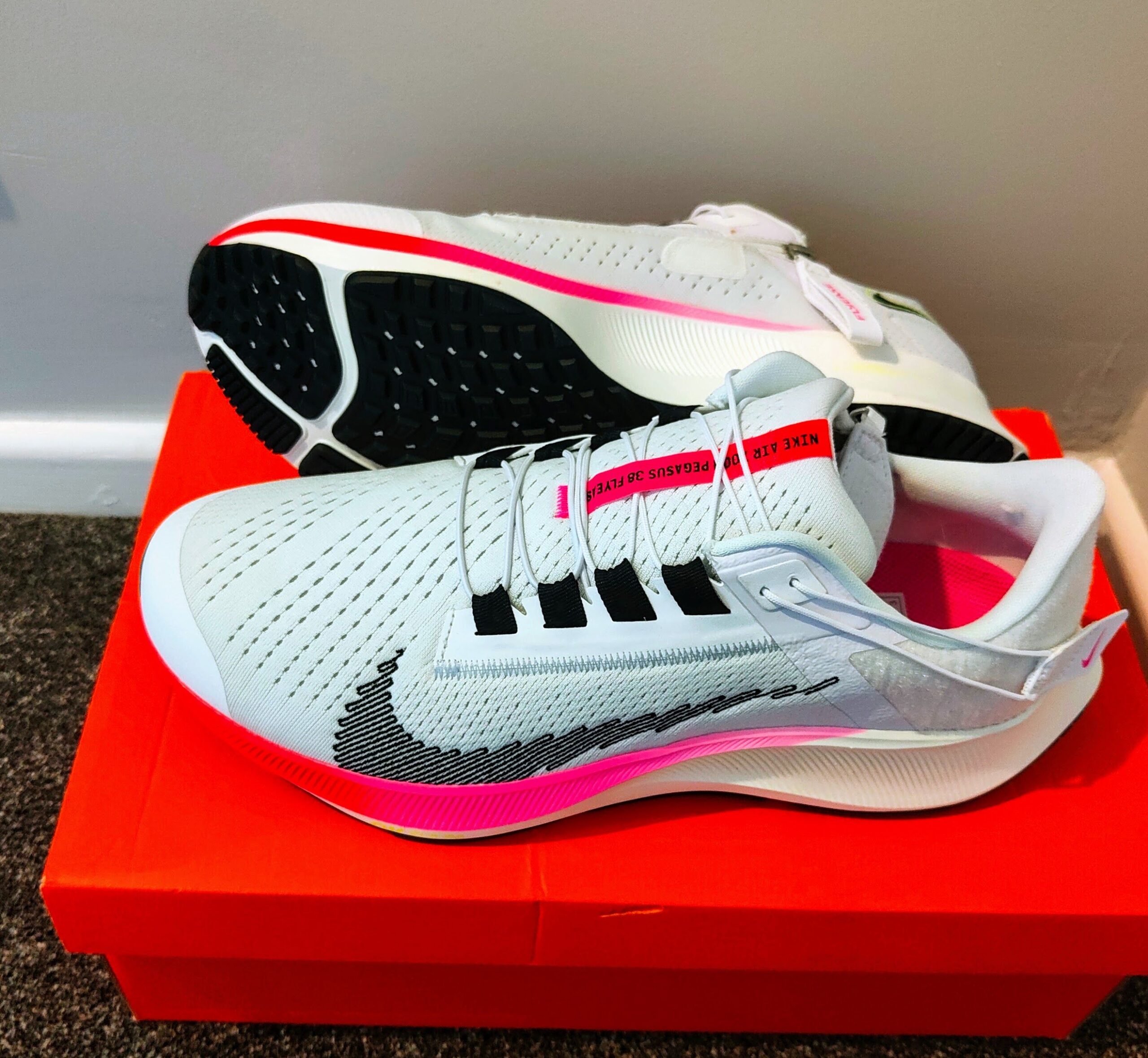
Headline facts
- Model: Nike Air Zoom Pegasus 38 FlyEase Wide
- Size reviewed: UK 10.5
- Width: Wide version
- RRP: £109.95
- Price I paid: £61.58
- Test distance: Just over 100 miles, including a marathon-length first run
All reviews on this site are based on products I have bought and used myself. I review them according to how they perform for me, so they are offered as a guide rather than a universal judgement. I also update reviews periodically to reflect longer-term performance, not just first impressions. It is worth checking back occasionally. The Pegasus 38 has since been replaced in Nike's range, so the original product link has been removed and this review is kept as a long-term record of how the shoe performed.
First impressions
Nike describes the Pegasus 38 FlyEase as a “workhorse with wings”. My first impression was that the description was fair.
These are not the lightest trainers around, but I did not notice the weight once I was wearing them. They felt well cushioned and supportive for their weight, with the sort of construction that suggested I could put good mileage into them before they started to break down.
The rubber sole looked tough and had a decent amount of tread for grip. The overall shape was sleek and fast-looking, and Nike offers the shoe in a wide range of colour schemes.
I do not normally choose bright colours. I buy trainers to run in, not to look good, so I went for the cheapest colour available. With Nike, a different colour of the same shoe can often be substantially cheaper, so it is always worth checking all the available options before buying.

Fit and the FlyEase system
I have wide feet, so I ordered the wide version in my usual UK 10.5. They felt true to size straight away.
I have not worn the standard-fit Pegasus 38, or any previous Pegasus model, so I cannot make a direct comparison between the standard and wide versions. I can only describe how this pair fitted me.
The fit was very comfortable. There was substantial cushioning underfoot and plenty of room in the toe box. Nothing pressed against my toes, and I did not feel the need to size up.
The FlyEase system was new to me. I only ordered this version because the model was on offer, rather than because I was specifically looking for an easy-entry shoe.
The system uses a zip and quick-lace arrangement. I was initially concerned that I might feel the zip against my foot, but that concern proved unfounded. The shoe was comfortable from the first time I put it on, with no discomfort in any area.
The quick-lace system also looked as though it would make small adjustments straightforward. That proved to be mostly true, although I did find one issue later in the first run.

The test run
For the first run, I broke all the rules.
I went out for four hours with the intention of speeding up during the second half. A few months after a big event, my fitness was not really at the level needed for that yet, but I tried anyway.
The route included road, pavement and a tree-lined cycle track. Most of the cycle track was gravelly tarmac, with a small wooden boardwalk section.
I headed out at a steady 8:45 min/mile pace. The Pegasus felt natural immediately. It had a lovely cushioned feel but still offered a nice spring through the stride.
I could happily wear these for long, easy runs. At the same time, I felt confident that they would respond if I wanted to run faster, including during interval sessions. They did not feel like a soft, slow shoe that only worked at one pace.
That balance was one of the strongest features of the Pegasus 38 FlyEase. It felt comfortable without feeling dull.
Grip and wet weather
The grip was good on the road and pavement. The shoes also handled greasy leaves on the cycle track well.
It was a wet day, and the wooden boardwalk was extremely slippery. I did lose some grip there, but I could carry on running normally without having to take extra care with every step.
I would not expect a road shoe to behave like a trail shoe on a wet wooden surface. On the normal surfaces I encountered during the run, the outsole performed well.

The rain seemed to run straight off the trainers rather than soaking into them and adding noticeable weight. My feet were very wet by the end of the run, though, which made me suspect that the upper was not particularly breathable.
I had no rubbing problems despite having wet feet for a long time. That is worth noting because wet feet and a badly fitting upper can quickly turn into a problem over marathon distance.
The lace adjustment issue
After about 13 miles, the shoes still felt comfortable, but I felt they needed tightening.
That is not a problem in itself. This was the first wear, so some adjustment was to be expected. The FlyEase system should make that adjustment quick.
The issue was with how far the laces could be tightened. The laces are adjusted by pulling the end and attaching it to Velcro on the heel of the trainer. When I tightened them to the level I wanted, I pulled the laces beyond the Velcro tab. I could not adjust them any further.
I accept that the Pegasus may be quite accommodating in the width, and a normal rather than wide fit may have suited me better. However, it is worth being aware of this if you have wide feet and are considering the wide version.
I carried on and completed a marathon without any discomfort or rubbing, despite not being able to make any further adjustment. So it was not a serious problem during that run, but I would have preferred a little more scope in the lacing system.

Verdict after 26 miles

After just over 26 miles, I thought the Pegasus 38 FlyEase was a very comfortable trainer with good grip on the surfaces I would expect to encounter during a normal run around the streets.
It suited the steady pace of this run well. Despite having no break-in period, the shoes were comfortable from start to finish.
After that first run, there were no obvious signs of wear to the upper or sole. The cushioning remained consistent, and the shoes still felt supportive when I was tired.
The only real negative was the lacing. I would have liked some way to shorten the lacing system, which would have allowed more adjustment. It is possible that the normal-width version would have fitted me better, but I chose the wide version because of my feet and it was comfortable overall.
After one marathon-length run, my view was that these were comfortable, versatile daily trainers with enough response for faster work and enough cushioning for longer easy runs.
100 mile update: 21/11/2021
A few miles short of 100 miles, the trainers were still like new.
There was no visible wear on the sole, and they still had plenty of bounce. The upper was also holding up well.
I had overcome the lace adjustment issue by twisting the cord that attaches the Velcro tab. This shortened the cord and allowed me to get the adjustment I wanted. It worked well.
At the price I paid, £61.58, these were looking like a very good-value daily trainer. They had been comfortable over long distances, had coped with roads, pavements and gravelly tarmac, and were showing no obvious signs of breaking down.
Closing thoughts
The Nike Pegasus 38 FlyEase Wide worked well for me as a comfortable, durable daily trainer. The fit, cushioning and outsole stood up well over the first 100 miles, with the lace adjustment system being the only issue I needed to work around.


