

Forty-three miles from Brecon to Nantgarw and fourteen hours to complete it. The maths looks generous until mud, tired legs, checkpoints, darkness and the temptation to go off too fast start taking their share.
TL;DR: The 14-hour cut-off gives you an average of roughly 19:32 per mile, including every stop and walk break. You do not need to run every mile at that pace, but you do need to manage the whole day properly. The first 20 miles should feel controlled, the Merthyr change from trail to tarmac needs specific preparation, and the cut-off is usually decided in the final third.
The key facts
- The Brecon to Cardiff Classic is 43 miles along the Taff Trail.
- Race day is Sunday 14 February 2027.
- The route runs from Brecon to Nantgarw.
- The first 7 miles from Brecon, along the canal, are flat.
- Once the route leaves the canal, the long climb towards Torpantau, the high point, begins, before the route gently loses height almost all the way to the finish.
- The climb is long and gradual rather than steep. There is no sharp gradient that forces you to walk, so the effort creeps up on you.
- The cut-off is 14 hours.
- Around 20 miles of the route is asphalt and 13.7 miles is gravel, with most of the rest paved. The gravel comes early, before Merthyr.
- From Merthyr onwards the route follows an off-road cycle path, mostly tarmac, all the way to Nantgarw. There are five checkpoints, at Talybont-on-Usk, Pontsticill, Merthyr, Aberfan and Pontypridd.
- There is a drop bag station at Merthyr, at Cefn Coed Community Centre around 22.4 miles, which is the official point for switching from trail to road shoes. There is no supporter access or parking there, and supporters should park near Merthyr College.
- February can bring mud, standing water, saturated ground and cold conditions.
- Most of the field will finish after sunset.
I have run this race, including in Storm Ciara conditions. I know the concern about the cut-off is not theoretical. You can feel it sitting in the back of your mind before the start, especially if this is your first long ultra.
The answer is not to panic and start faster. It is to understand what the clock is asking from you.
Check the organiser's current event information on the Run Walk Crawl page before race day, including any updates to the route, compulsory kit and logistics.
What 14 hours actually means per mile
Fourteen hours is 840 minutes.
Divide 840 minutes by 43 miles and the result is approximately:
19 minutes and 32 seconds per mile
That is just under 12 minutes and 15 seconds per kilometre.
At first glance, that may appear achievable. However, this is an average required for the entire event, not a pace to run at from Brecon.
That average includes:
- Time spent at checkpoints
- Refilling bottles
- Sorting clothing or navigation
- Walking the sections where the effort rises
- Slowing down through mud and standing water
- Dealing with niggles
- Eating and drinking
- Finding your rhythm again after a stop
- The loss of daylight
- The tarmac section when your legs are already tired
That is the trap of this route. The first 7 miles along the canal are flat, and flat miles invite you to run them too hard. Then you leave the canal and the long climb towards Torpantau begins. The climb is gradual, with no sharp gradient that forces you to slow down and walk, so the effort creeps up on you rather than announcing itself. On a steep mountain route the terrain does some of the pacing for you. Here, nothing does it for you until it is too late.
If you stand still for ten minutes, the average pace required for the moving time becomes quicker. If poor conditions slow you down early, you need to absorb that time somewhere else.
This is why I do not tell athletes to stare at one pace number all day. The watch is useful, but the watch does not understand the surface under your feet or the state of your legs.
Why the average pace is the wrong thing to chase
The obvious mistake is setting off from Brecon trying to hold 19:32 per mile.
That pace might feel comfortable on a firm section early in the day. It might even feel too slow. The temptation is to bank a little time while your legs are fresh.
I would resist that approach.
The first 20 miles should be deliberately controlled. You start with 7 flat miles along the canal out of Brecon, where your body will be fresh and the pace will feel easy, and then the long climb towards Torpantau begins. That is exactly when people discover they have spent too much already.
Time cannot be banked safely if you spend the energy required later.
The aim is not to make the first part look impressive on your watch. The aim is to arrive at the Merthyr switch with enough movement left in your legs to deal with the next section properly.
A sensible early approach might include:
- Running the flat opening miles comfortably, well short of race effort.
- Easing off on the long climb before your breathing becomes ragged, rather than pushing on because the gradient looks gentle.
- Keeping the easier, gently downhill running controlled rather than getting carried away on it.
- Taking food and drink before you feel empty.
- Keeping checkpoint stops short and purposeful.
- Checking your overall progress instead of reacting to every individual mile.
If you are anxious about the cut-off, this can feel uncomfortable. You may worry that controlled pacing means falling behind. In reality, the early miles are where you protect the system you will rely on later.
The starting line is never just physical. Work pressure, poor sleep, anxiety, low mood or strain at home can affect how much recovery you absorb between sessions. I account for those factors when I coach an athlete because the plan has to fit the person arriving at the start, not an imaginary runner with unlimited energy.

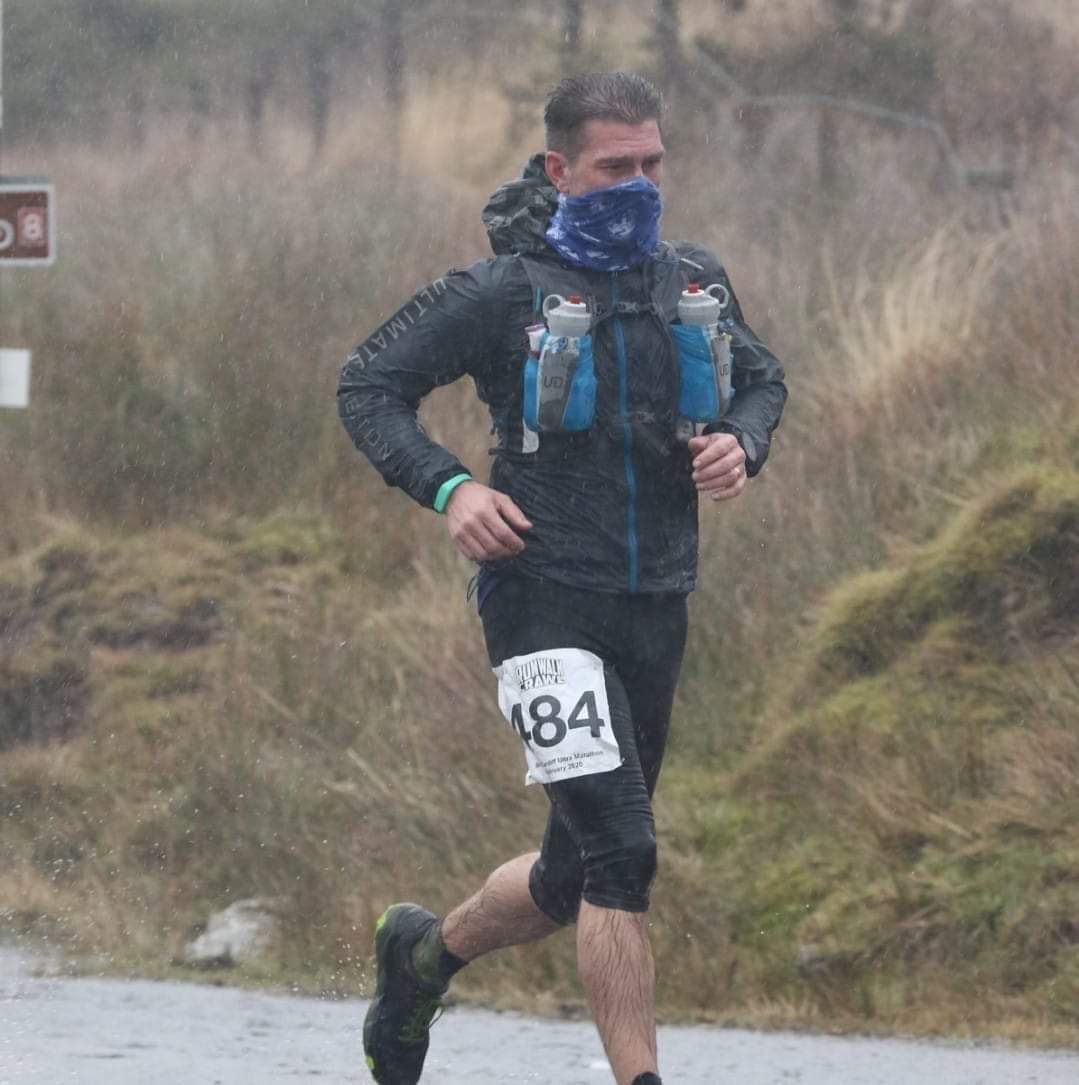
From the Classic itself: soaked through on a stone bridge and still moving. This is what a wet February on the Taff Trail looks like.
The Merthyr switch
The change at Merthyr is a major point in the race.
Around 20 miles of the route is asphalt and 13.7 miles is gravel, with most of the rest paved. The gravel comes early, before Merthyr. From Merthyr onwards, the route follows an off-road cycle path, mostly tarmac, all the way to Nantgarw. A mostly tarmac surface sounds easier, and it is not automatically easier for tired legs. There is a drop bag station at Merthyr, at Cefn Coed Community Centre around 22.4 miles, which is the official point for switching from trail to road shoes. There is no supporter access or parking there, and supporters should park near Merthyr College.
I have seen the change catch runners out because they assume tarmac will feel like a recovery section. The surface is more predictable, but it can expose a different set of weaknesses:
- Calf and Achilles loading from repeated foot strikes
- Tired hips struggling to maintain posture
- Quads that have already absorbed hours of steady, unbroken running
- A shortened stride caused by fatigue
- Feet becoming sore inside wet shoes
- A steady loss of movement when the surface stays the same mile after mile
The later miles break more people than the early ones, because they arrive when the body has already absorbed a long day of near-constant running.
That is why long trail runs alone are not enough preparation. Your training should include tarmac durability sessions. This does not mean forcing hard efforts on tired legs. It means practising controlled, economical movement on firm surfaces when you are carrying some fatigue.
Useful preparation can include:
- Easy running on tarmac after a longer trail session
- Steady sections on cycle paths or pavements
- Purposeful walk-run sessions on firm ground
- Practising your race shoes on both trail and tarmac
- Strength work that supports the calves, hips and trunk
- Learning how to shorten your stride without shuffling badly
The goal is to arrive at Merthyr with another gear available. It may be a slow jog. It may be a strong walk. It may be a repeated run-walk pattern. The important point is that you can keep moving without turning every step into a negotiation.
What is actually on the route
The course works out at 43.3 miles, with the highest point at 440 metres and the lowest at 40 metres. There is one notable descent on the route, which averages around 6 per cent over about 0.6 of a mile. Everything else is gradual. There are no steep climbs and no steep descents.
Roughly 20 miles of the route is asphalt and 13.7 miles is gravel, with most of the remainder paved surface. So it is a hard-surface route rather than a technical trail, and the gravel comes early, before Merthyr.
There are five checkpoints, and knowing what is where settles a lot of pre-race nerves:
- CP1: Talybont-on-Usk, around 6.8 miles. This is roughly where you leave the canal and the climbing starts.
- CP2: Pontsticill, around 16.1 miles. No supporter access or parking.
- CP3: Merthyr, at Cefn Coed Community Centre, around 22.4 miles. This is the drop bag point. No supporter access or parking, and supporters should park near Merthyr College.
- CP4: Aberfan Leisure Centre, around 28.7 miles.
- CP5: Pontypridd, at Honky Tronk Cafe, around 37.7 miles.
The spacing of those checkpoints matters more than the total distance, because the gaps between them shape how much you carry and when you eat. Look at the gap between Merthyr and the finish and plan your fuelling around it rather than around the race as a whole.
Where the cut-off is actually won and lost
The cut-off is often won or lost in the final third, on the flat tarmac, when the legs have very little left.
It is also influenced by the first third, when runners decide whether to spend energy they will need later.
That is the race management problem.
A runner can be moving at a reasonable pace early on but still reach the final 10 to 15 miles with no useful movement left. Another runner may appear slower through the Beacons but continue running and walking with purpose after Merthyr.
The second runner is usually in the stronger position.
I want athletes to think in terms of available movement, not just pace. Can you still:
- Walk the long climb with a steady rhythm when the effort rises?
- Jog a flat section without forcing it?
- Eat before hunger becomes a problem?
- Adjust clothing before getting cold?
- Deal with a niggle before it changes your stride?
- Navigate without stopping for long periods?
The official course information says the route is marked, but I would still carry the required navigation setup and load the race GPX onto a running watch or phone. Komoot can also be useful before race day for familiarising yourself with sections of the Taff Trail and understanding how the route changes around Merthyr.
You are not trying to eliminate every problem. You are trying to solve small problems before they become large ones.
Three things to sort before February
1. Practise walking on purpose
Do not leave walking until you are exhausted.
Practise walking the long climb with good posture, purposeful arm movement and a pace you can sustain. On this route the climb is gradual rather than sharp, so get used to noticing when the effort is rising and easing off before it costs you. Then practise returning to an easy jog without needing a long reset.
Walking is not failure. Unplanned, slow shuffling for miles because you have overcooked the early section is a different problem.
2. Rehearse fuelling for eleven or twelve hours
A 14-hour cut-off does not mean you should only prepare for a short day. Rehearse the food and drink you can tolerate over eleven or twelve hours.
Test different gels, chews and ordinary foods during long sessions. Practise taking small amounts regularly rather than waiting until your stomach is empty or your concentration has dropped.
Do not introduce a completely new fuelling system on race day.
3. Get out on tired legs in the dark
February conditions can leave you finishing after sunset. A head torch should not be an unfamiliar piece of kit.
Run or walk on safe, familiar routes in darkness. Practise using your navigation, adjusting layers and managing wet kit while tired. Learn how your pace and confidence change when visibility is reduced. If you want more practical guidance on running in the dark, I have covered that in more detail in a separate post on night running for ultras.
The aim is not to make darkness exciting. It is to make it ordinary enough that you can keep solving practical problems.
Key takeaways
- The 14-hour cut-off requires an overall average of about 19:32 per mile, including stops and walking.
- That figure is not a target pace to hold continuously.
- The first 20 miles should be controlled rather than used to bank time.
- The Merthyr switch from trail to tarmac needs specific preparation.
- Tarmac durability is as important as trail endurance for this race.
- The final third is where tired legs, cold, darkness and poor fuelling can expose earlier decisions.
- Purposeful walking, rehearsed fuelling and dark-running practice should be part of your preparation.
Frequently asked questions
Do I need to run every mile at 19:32?
No. That is the average required across the complete event. It includes checkpoint time, walking, surface changes and other delays.
Is the Brecon to Cardiff Classic a trail race or a road race?
It is a hard-surface route rather than a technical trail. Around 20 miles is asphalt and 13.7 miles is gravel, with most of the rest paved. The gravel comes early, before Merthyr, and from Merthyr onwards you are on an off-road cycle path, mostly tarmac, all the way to Nantgarw.
Should I try to gain time in the first 20 miles?
I would not make early speed the main objective. Controlled pacing protects the energy you need for the Merthyr section and the final third.
Will I be running in the dark?
Most of the field finishes after sunset in February, so you should prepare for darkness and carry the required lighting and navigation equipment. If you want a practical starting point, see my post Night Running for Ultras: Training for the Dark Hours.
Can I beat the cut-off?
Possibly, but the answer depends on your current ability, training history, recovery, fuelling, pacing and the conditions on the day. I cannot promise a finish time, but I can help you assess the demands honestly and build preparation around your actual life.
Where are the checkpoints on the Brecon to Cardiff Classic?
There are five: Talybont-on-Usk at around 6.8 miles, Pontsticill at around 16.1 miles, Merthyr at Cefn Coed Community Centre at around 22.4 miles, Aberfan Leisure Centre at around 28.7 miles, and Pontypridd at around 37.7 miles. Merthyr is the drop bag point. There is no supporter access or parking at Pontsticill or Merthyr, and supporters are asked to park near Merthyr College.
If you want a broader local comparison first, I have also written about five ultras in South Wales, including how races in the area differ in terrain, feel and demands.
If you are considering the Brecon to Cardiff Classic and want an honest view of what the event will require, contact me through PFM Coaching. I can help you look at the course, your current training and the decisions needed to reach Nantgarw with something left in your legs.


